
Revised (& Expanded) Rolling Reaction

This procedure will be part of the upcoming new edition of VIII·XII·XX, namely in the chapter ‘Personæ’ dedicated to NPCs and it is a revision of the previously published post here with the same title. Some thoughtful readings helped me to review it with a more plausible approach and expand it with a well-known theory, kudos to the fellows and their inspiring ideas you will find at the links quoted at the end!
The Revised Procedure
This procedure isn’t strictly necessary, since VI·VIII·X leaves all interpersonal and social relations to pure role-play between players and GM. Still, if the GM wants a dash of randomness in those interactions, this procedure can be applied before starting role-play.
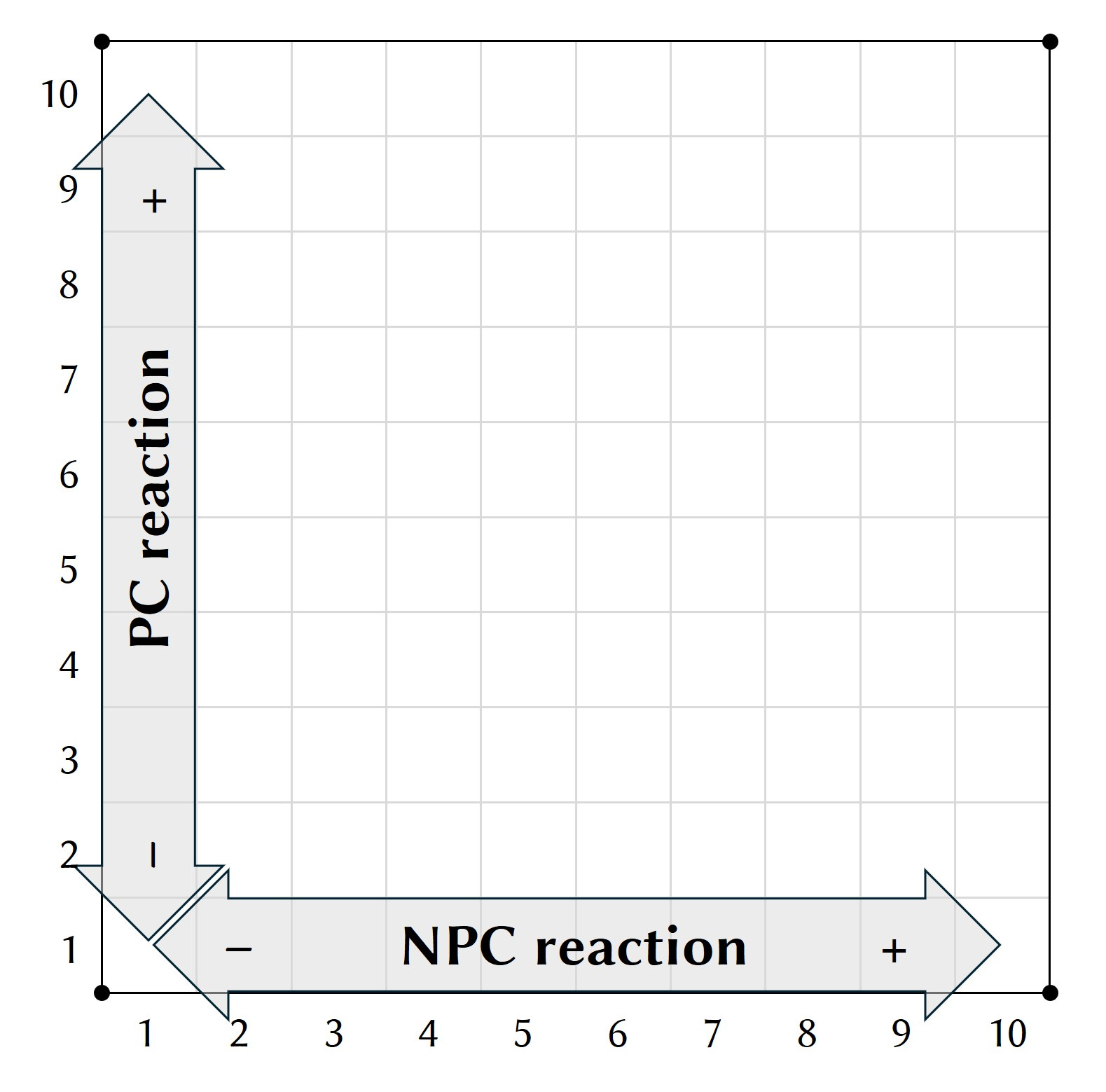
The system works on a four-quadrant graph:
On the X-axis the GM sets the NPC’s starting reaction, rated 1 to 10 (1 = negative, hostile; 5/6 = neutral, indifferent; 10 = positive, friendly); this can be rolled or predefined.
On the Y-axis the player declares the PC’s starting reaction, same 1–10 scale.
You can apply this approach to individuals or homogeneous groups the same way.
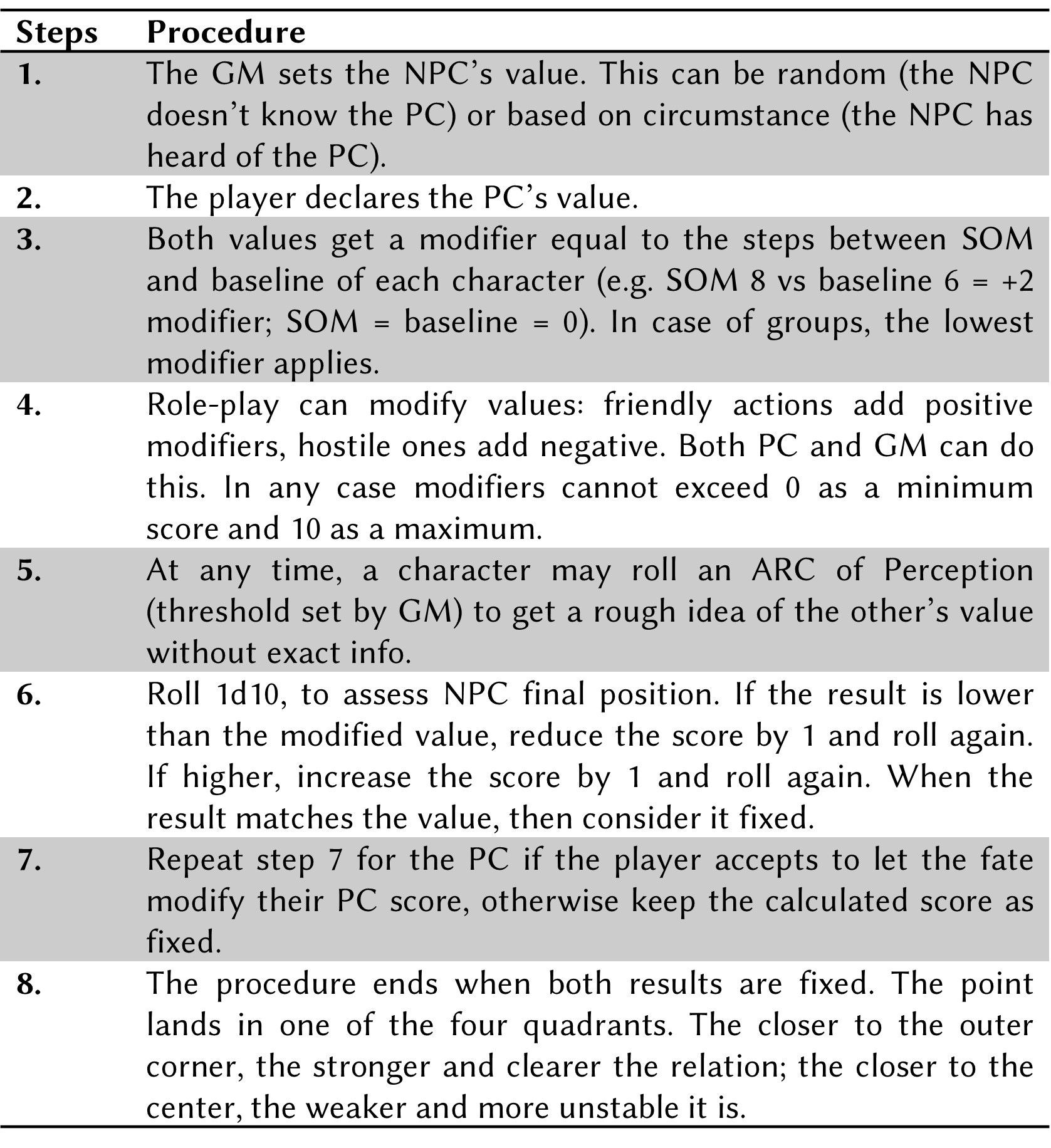
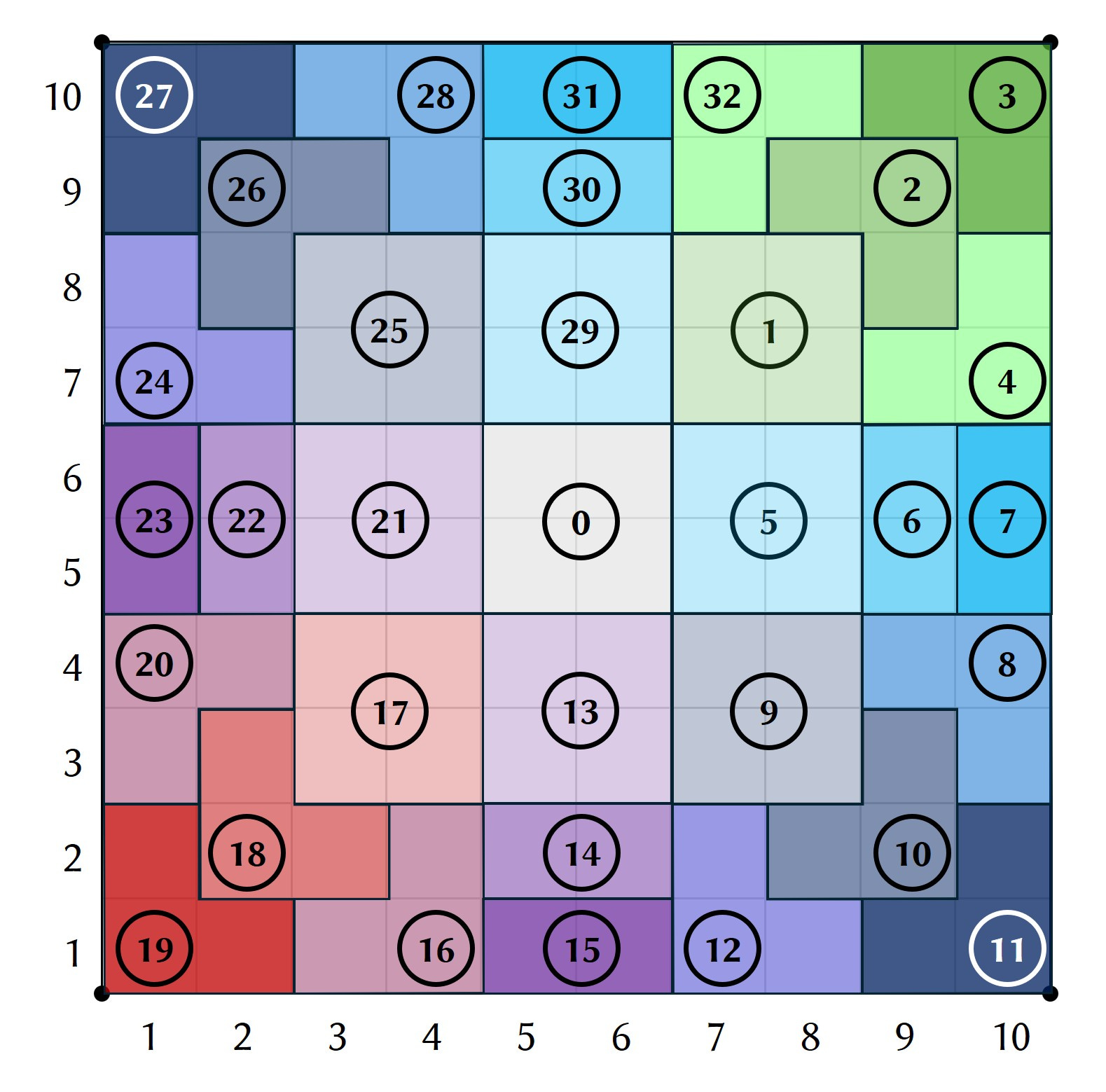
The fixed scores generate a position in a specific area according to the keyed reaction graph and the keyed reaction table below.
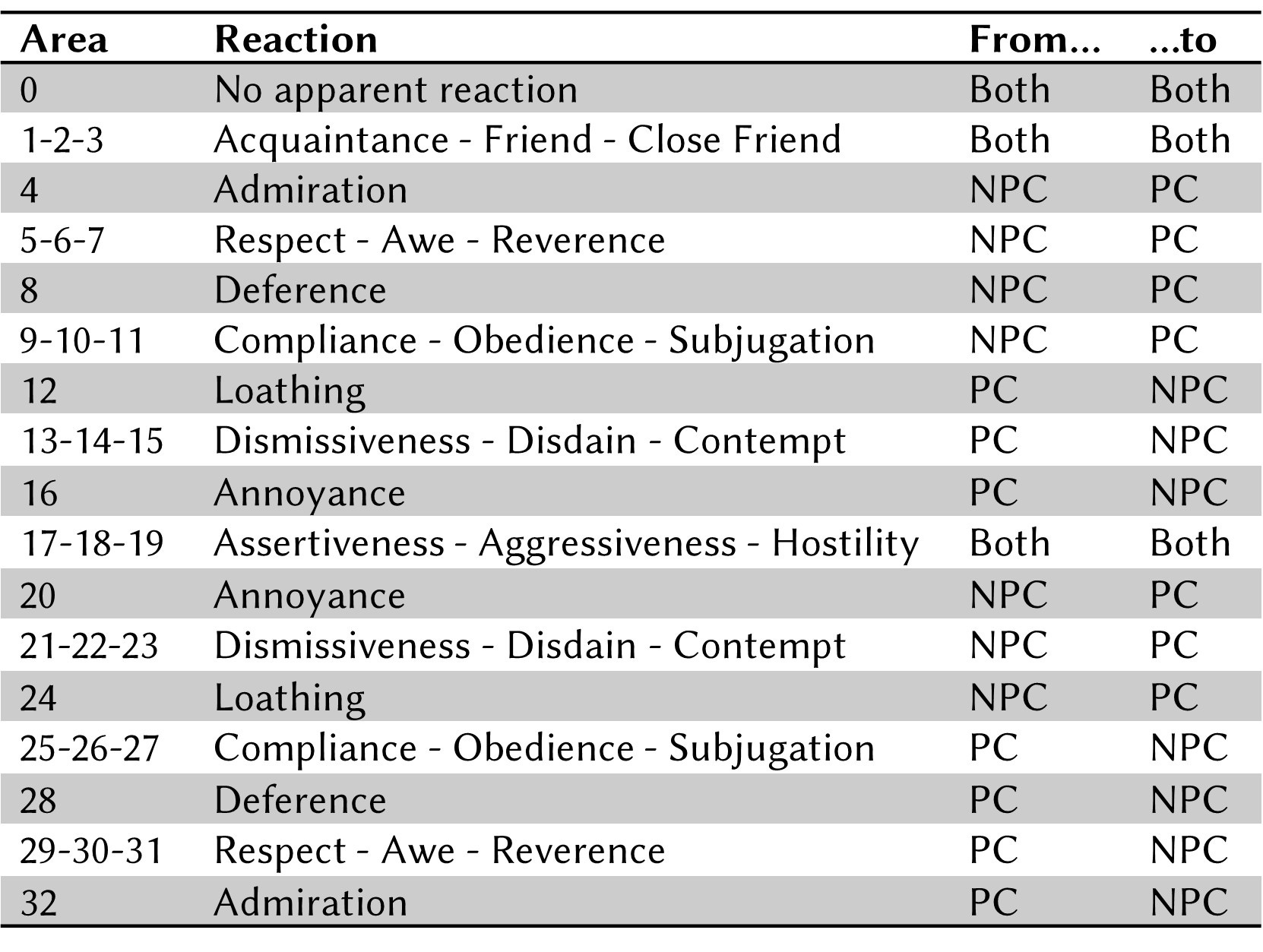
In a nutshell:
Players and GM follow the procedure until a point on the graph is determined, identifying the reaction between the two parties.
Based on that point on the graph, the GM determines the PC/NPC’s reaction according to the table’s guidelines.
The encounter then develops following this definition. Each area of the graph is detailed in the table, which outlines the possible reactions depending on the zone reached. Some areas of the graph have nuances of a more general reaction (e.g. acquaintance/friend/close friend are increasing tones of a positive reaction).
The only area without specific guidance is the central one (Zone 0): here, no particular reaction emerges from either party. In this case, the GM should adapt the result to the situation (e.g., the character remains indifferent, distracted, or focused on something else, and does not display any notable reaction).
Alternatively, if the submitted character (for reasons like Morality, background, or similar) cannot accept the outcome, the fallback option is escape or any action necessary to exit the situation; this is valid for both PCs and NPCs.
In addition… If the GM wishes to further refine the outcome, an further step may be applied to this procedure. This step answers the following question: “Once it has been established, for instance, that the NPC feels admiration toward the PC, how does this reaction translate into narrative terms?”
(The second part of the procedure is designed to provide guidance on exactly this aspect)
The Expanded procedure
How to deploy as in-game interactions the outcomes of the keyed reaction graph and table? This can be worked out by the GM narrative skills or by applying the reactions to a specific personality and decline the outcome in narrative terms. The model used here is the ‘Big Five OCEAN’.
Key Characteristics of the Model
The Big Five provides a clear, flexible way to understand personality by explaining how people tend to think, feel, and behave, without boxing them into rigid types. The model is based on five dimensions: everyone has an unique combinations of all five traits, and traits are dimensions, not categories. This model is descriptive, not evaluative, no trait is inherently “good” or “bad”.
The Five Dimensions (OCEAN)
1. Openness to Experience - Reflects curiosity, imagination, and openness to new ideas.
High: creative, intellectually curious, open‑minded
Low: practical, conventional, prefers routine
2. Conscientiousness - Measures self‑discipline, organization, and goal‑directed behavior.
High: reliable, organized, deliberate
Low: spontaneous, flexible, disorganized
3. Extraversion - Describes energy, sociability, and orientation toward external stimulation.
High: outgoing, assertive, energetic
Low: reserved, quiet, internally focused (introverted)
4. Agreeableness - Concerns cooperation, empathy, and concern for others.
High: kind, trusting, cooperative
Low: competitive, critical, skeptical
5. Neuroticism - Indicates emotional stability and sensitivity to stress.
High: anxious, emotionally reactive, vulnerable to stress
Low: calm, resilient, emotionally stable
The ‘stardard’ profiles
Based on the concepts explained so far, any GM is able to build up from the scratch an NPC by tuning the 5 dimensions as he prefers. From this model, no official profiles exist, however several standard default profiles are available online such as the following eight:
1. Leader - A confident, energetic personality marked by high Extraversion and strong Conscientiousness. Leaders thrive in group settings, take charge naturally, and project a sense of direction and purpose.
2. Supporter - Warm, cooperative, and steady, the Supporter scores high in Agreeableness and moderate-to-high Conscientiousness. They value harmony, trust, and teamwork, and excel at keeping groups cohesive.
3. Innovator - Curious, imaginative, and drawn to novelty, the Innovator shows high Openness to Experience. They love unconventional ideas, creative expression, and exploring new possibilities.
4. Analyst - Highly rational and analytical, with high Openness and low Agreeableness. Analysts value logic over emotion, question assumptions, and often excel in strategy, puzzles, and problem‑solving.
5. Diplomat - Socially graceful and deeply empathetic, the Diplomat scores high in Agreeableness and Extraversion. They navigate social environments with ease, thrive on connection, and smooth over conflicts.
6. Executor - Disciplined, structured, and reliable, the Executor is high in Conscientiousness and often lower in Openness. They prefer order to chaos and follow rules, routines, and responsibilities with precision.
7. Independent - Reserved, self-reliant, and emotionally detached, the Independent tends toward low Agreeableness and low-to-moderate Extraversion. They don’t seek approval and keep others at arm’s length.
8. Sensitive - Emotionally reactive and perceptive, the Sensitive profile is marked by high Neuroticism. They feel danger, tension, and subtle emotional shifts intensely, making them intuitive but easily stressed.
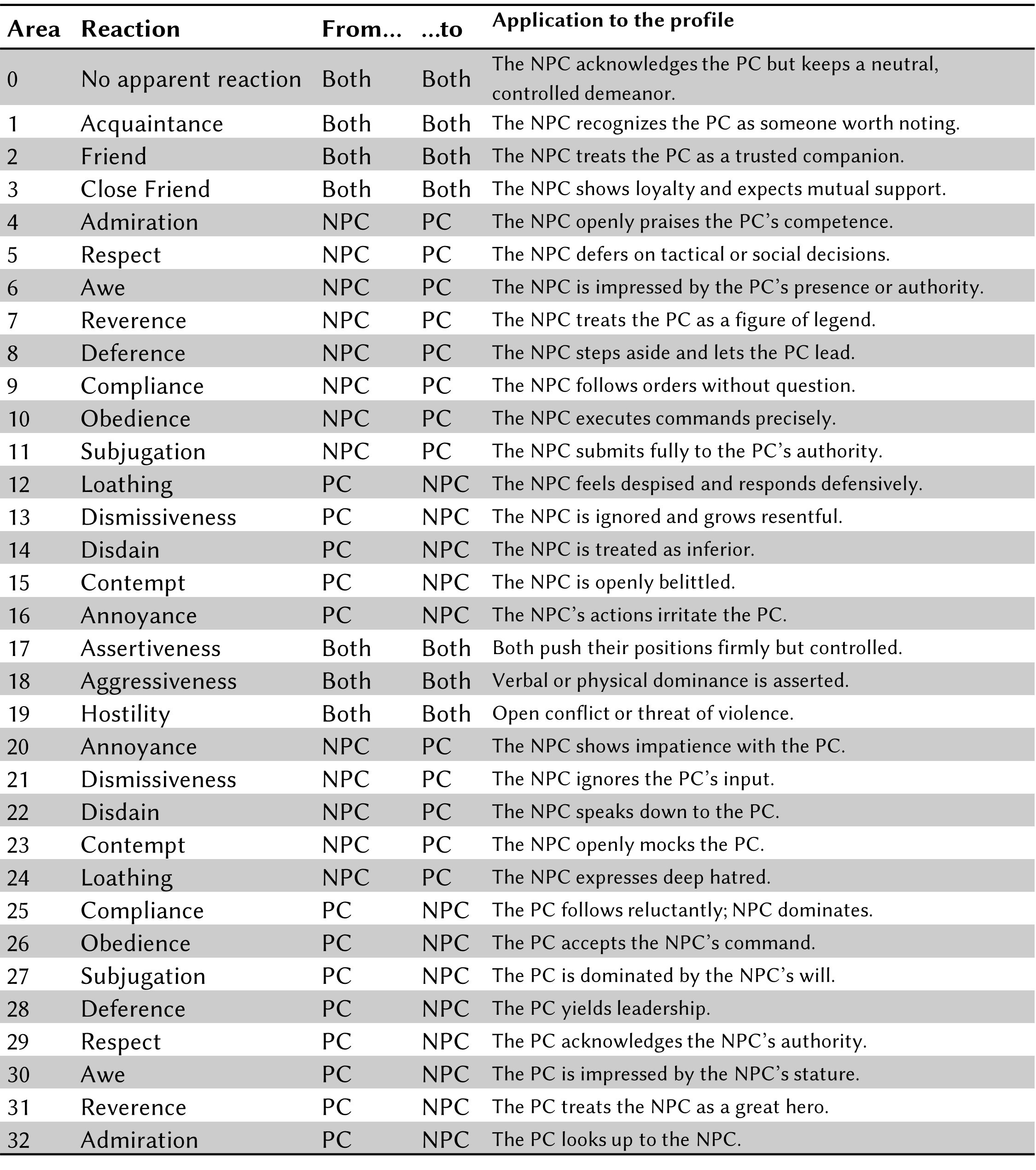
The GM can play with the five dimensions to draw the profile of an NPC and assign a concrete action to every area of the reactions keyed table. Here below a full application to the Leader (as an NPC) profile followed by selected examples for the other remaining profiles to complete the picture.
NPC Profile: Leader
NPC Profile: Supporter
Core tone: warm, accommodating, harmony‑seeking.
Positive zones → sincere praise, offers help
Neutral zones → eager cooperation
Negative zones → avoidance, visible discomfort
Example for Area 4 (Admiration): “The NPC expresses heartfelt appreciation and offers assistance.”
Example for Area 19 (Hostility): “The NPC withdraws, seeking to de‑escalate or leave.”
NPC Profile: Innovator
Core tone: curious, expressive, unconventional.
Positive zones → animated enthusiasm
Neutral zones → playful detachment
Negative zones → ironic or provocative responses
Example for Area 6 (Awe): “The NPC is inspired, asking questions and imagining possibilities.”
Example for Area 23 (Contempt): “The NPC responds with scornful sarcasm.”
NPC Profile: Analyst
Core tone: rational, detached, critical.
Positive zones → intellectual acknowledgment
Neutral zones → reluctant, logic‑based
Negative zones → cold, precise confrontation
Example for Area 5 (Respect): “The NPC recognizes the PC’s strategic value.”
Example for Area 19 (Hostility): “The NPC dismantles the PC verbally with logic.”
NPC Profile: Diplomat
Core tone: socially skilled, graceful, empathetic.
Positive zones → courteous and affirming
Neutral zones → polite distance
Negative zones → restrained but clear disapproval
Example for Area 8 (Deference): “The NPC diplomatically yields the spotlight.”
Example for Area 15 (Contempt): “The NPC maintains etiquette while subtly belittling.”
NPC Profile: Executor
Core tone: disciplined, rule‑oriented, rigid.
Positive zones → strict obedience
Neutral zones → expects compliance
Negative zones → procedural enforcement
Example for Area 10 (Obedience): “The NPC follows orders to the letter.”
Example for Area 18 (Aggressiveness): “The NPC escalates by enforcing rules or force.”
NPC Profile: Independent
Core tone: distant, self‑reliant, aloof.
Positive zones → minimal engagement
Neutral zones → emotional distance
Negative zones → cold rejection
Example for Area 0 (No reaction): “The NPC keeps to themselves.”
Example for Area 24 (Loathing): “The NPC cuts all interaction.”
NPC Profile: Sensitive
Core tone: emotionally reactive, high stress sensitivity.
Positive zones → intense attachment
Neutral zones → guarded behavior
Negative zones → emotional outbursts or withdrawal
Example for Area 6 (Awe): “The NPC is overwhelmed, voice trembling.”
Example for Area 19 (Hostility): “Fear and anger erupt uncontrollably.”
…you can play with both parts of this procedure and try to sort out nice findings: I’d be happy (and eager) to read from you about your outputs!
Kudos to the inspirational readings for the current revision:
Reaction table overhaul by Murkdice
Great post. While reading, i thought to myself: "This is an almost psychotic level of depth for an NPC reaction procedure." But then I remembered I literally learned to code so I could implement my dungeon layout procedure faster. *sigh*, the things we do to enjoy elf game.
amazing content