
Optional rule: Factions (Part 2)

Layer 4 – Opportunities and Threats
Any event external to the faction can result in either an opportunity or a threat. Such an event may be caused by the actions of the PCs, by NPCs, or by the natural convergence of circumstances within the setting.
Below is a table showing examples of how the same event may be interpreted as either an opportunity or a threat for a faction, depending on context.
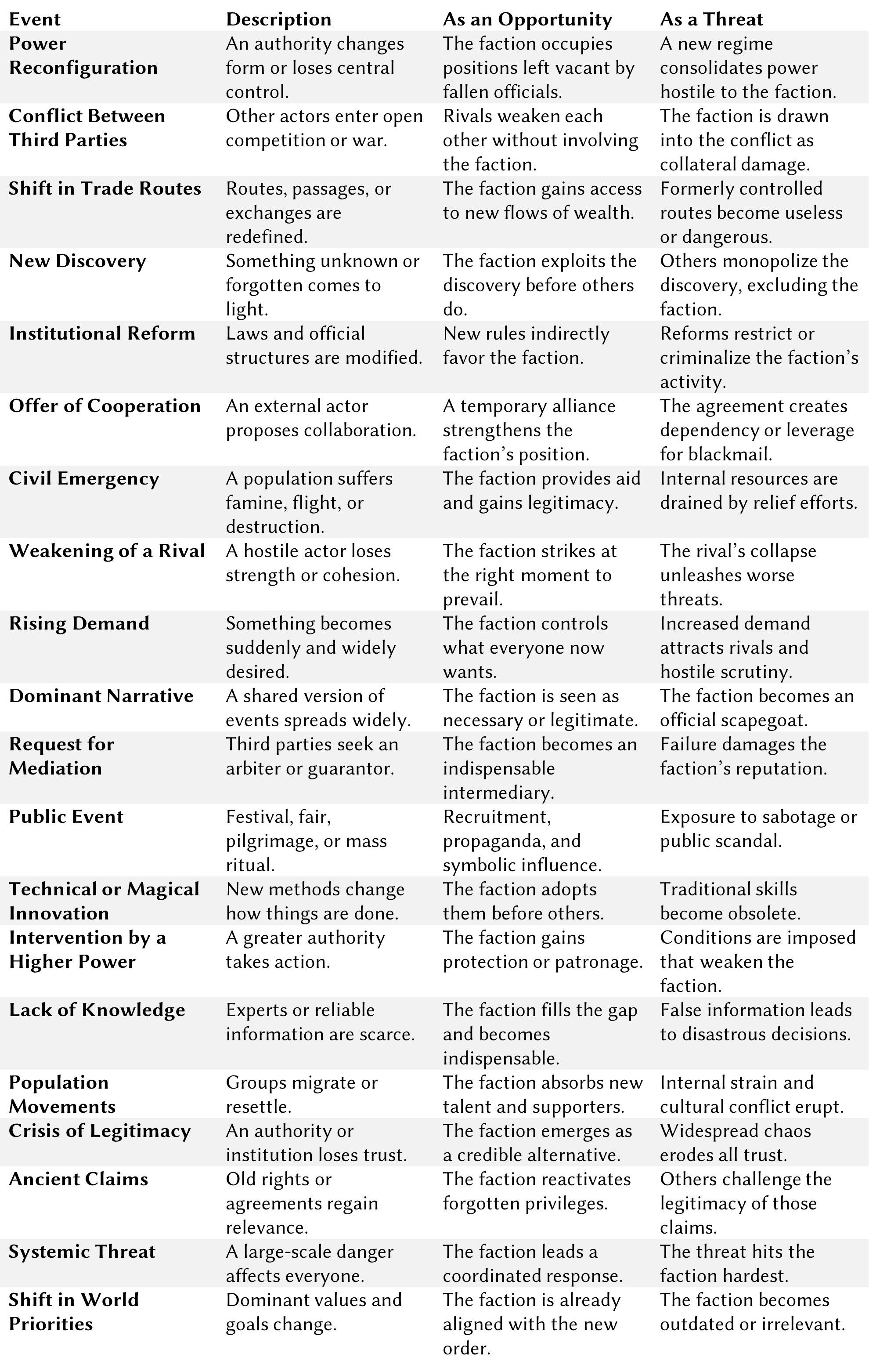
Based on the overall state of the campaign world, the GM decides whether an event manifests as a threat or an opportunity for a given faction. Players may influence this assessment through their actions.
Threats increase the faction’s tension level.
Opportunities reduce the faction’s tension level.
The tension mechanic and its effects are described in the section below.
Faction Evolution
The dynamics affecting a faction follow a flexible system adjudicated by the GM based on the situation.
If an opportunity or threat is not consolidated, it produces respectively a positive or negative reaction on the faction’s tension level table (see below).
If an opportunity or threat is consolidated, it generates respectively a new strength or weakness, or removes an existing weakness or strength.
Any change to a faction’s strengths or weaknesses produces a visible effect on the faction’s organization. The GM should apply a change in this sense to the faction’s organization.
Changes in organization may, in turn, affect the faction’s purpose. This is not automatic, but the GM should always consider the possibility.
Tension Level
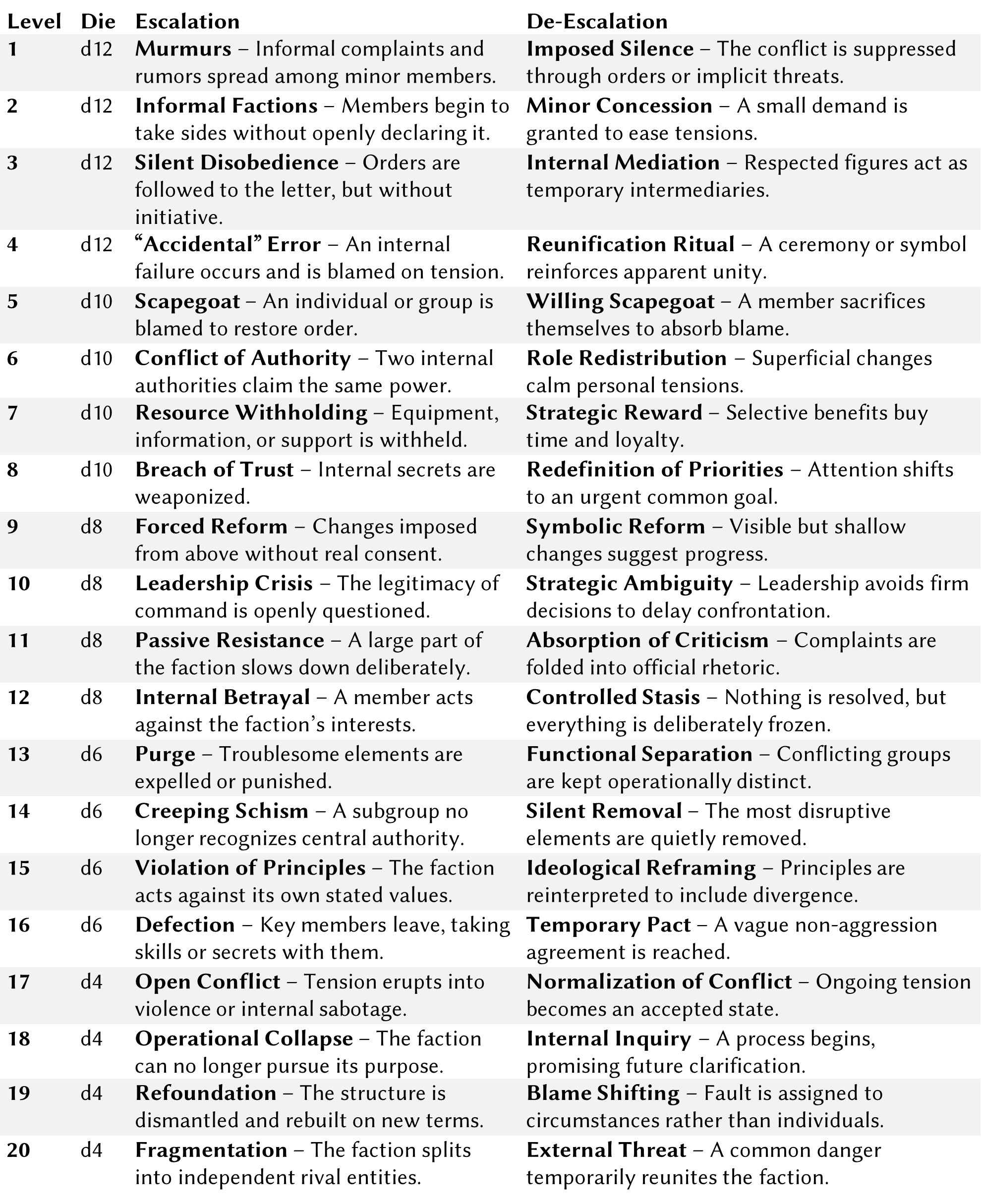
Every faction has a tension level, ranging from 1 (minimum) to 20 (maximum). The tension system works as follows:
Each negative or positive reaction increases or decreases tension by 1. The GM may apply a change of ±2 only in especially impactful situations.
After the tension level is adjusted, the GM rolls the die associated with the current level. If the result is 1–2, an escalation or de‑escalation occurs as described in the below table (or a similar event, at the GM’s discretion). Any other result means no additional effect, however the potential effect increases or decreases.
When a faction reaches tension level 1 and a de‑escalation is triggered, the faction gains one additional strength.
When a faction reaches tension level 20 and an escalation is triggered, the faction disbands.
Example of Faction Creation
STEP 1 – Layer 1: Purpose
The GM rolls 2d20 for the verbs and 2d20 for the subjects/objects, then selects the most interesting options.
Roll (simulated)
Verb: to preserve / to sabotage → chosen: to preserve
Object: tradition / wealth → chosen: tradition
Resulting Purpose
To preserve tradition: A broad, solid purpose, not tied to a single enemy. Ideal for a long‑lived faction that may come into conflict with any change in the world.
STEP 2 – Layer 2: Organization
Organization (1d20)
Roll: 2 → Order – A hierarchical structure with codified rules and initiation rites.
Method (1d20)
Roll: 18 → Sacralized Tradition – Customs and traditions are used to justify authority.
Layer 2 Result
A Traditionalist Order that legitimizes every decision by saying, “This is how it has always been done.”
STEP 3 – Faction Age
Freely chosen by the GM. Founded about 80 years ago, after a civil war.
Implications:
Possesses historical memory
Has seen multiple generations
Old enough to be difficult to dislodge
STEP 4 – Faction Size
The GM chooses a medium size, suitable for interacting with the PCs without dominating the setting.
Approximately 60 active members
STEP 5 – Member Levels and Hierarchy
With 66 members total:
1 Leader (Lev.7) → The unquestioned authority (High Abbot)
5 Lieutenants (Lev.5) → Each oversees a major chapter or doctrinal domain
15 Officers (Lev.3) → Local leaders, instructors, judges, and ritual overseers (three under each High Lieutenant)
45 Rank‑and‑File Members (Lev.1) → Distributed unevenly among the officers (in average three)
STEP 6 – Member Profiles
Members are defined by role and function, not as individual stat blocks.
Rank‑and‑File (Lev.1): Novices, scribes, ritual guards, custodians of texts, attendants of ceremonies. They enforce tradition locally but do not interpret it.
Officers (Lev.3): Instructors, local judges, archivists, ritual leaders. They interpret doctrine and ensure correct practice within their cells.
Lieutenants (Lev.5): Masters of doctrine, regional arbiters, keepers of sanctioned interpretation. They settle disputes between officers and report directly to the Leader.
Leader (Lev.7): Final authority on orthodoxy and tradition. Interprets the Law itself, resolves schisms, and defines what “tradition” means when challenged.
STEP 7 – Layer 3: Strengths and Weaknesses
With 60 members and significant age, the faction has 2 strengths and 2 weaknesses.
Strengths (2 rolls)
Rites and Traditions – Internal practices reinforce belonging and legitimacy.
Institutional Memory – Knowledge and precedents are preserved and applied.
Weaknesses (2 rolls)
Doctrinal Rigidity – Methods and goals change slowly and with difficulty.
Fear of Change – Every reform meets internal resistance.
An implicit structural tension emerges: the faction is strong because it does not change, but this very stability also makes it vulnerable. This affects Step 10.
STEP 8 – Resource Level
Based on age and purpose, faction’s resources: MEDIUM
Ownership of archives, relics, and ritual buildings
Little liquid wealth
Symbolic influence outweighs material power
STEP 9 – Faction Locations
Chosen according to the purpose.
A monastery‑fortress built over an ancient bridge (Leader’s headquarters)
Small ritual chapters in five towns (Lieutenants’ commands)
Archives closed to outsiders spread in the regions of the towns (Officers’ posts)
STEP 10 – Starting Tension Level
A stable faction, but under pressure from a changing world.
Tension Level: 8 No immediate escalation, but conditions are set.
FINAL RESULT
Name: The Order of the First Law
Purpose: To preserve tradition
Organization: Order
Method: Sacralized Tradition
Age: ~80 years
Size: 66 members
Strengths: Rites and Traditions; Institutional Memory
Weaknesses: Doctrinal Rigidity; Fear of Change
Tension: 8
Role in the World: guardian of “how things were done before”
Incredible levels of detail and thought have gone into this!