
In praise of imagination

I’m sure I’ve already written this before, and probably in a mess of broken, scattered thoughts. Let me start with this: I’m Gen X. My kids call me a boomer (wrongly, if you go by the actual definitions), but the point is, I often see things differently than younger generations.
One of those things is how we read, and how imagination works. When I was a kid, the best part of reading was getting a book with no illustrations. Just a cover, like a doorway into the world inside. The farther the story was from reality (fantasy, horror, sci-fi) the more that threshold felt like an open invitation to jump in and let your imagination do the heavy lifting.
Reading a book after seeing the movie adaptation? Everyone’s felt that disappointment, right? Everything in the text feels duller, flatter. That’s because you’re not imagining it anymore, you’re just recalling scenes someone else filmed. That’s not immersion, that’s playback. Okay, maybe I’m getting a little nostalgic here.
But here's the point: I’ve never understood the need to put images in RPG books, whether they’re rules, setting, or adventures. I’ve said this more than once: RPG books are among the few that absolutely demand imagination. Adding images introduces bias. It hijacks the GM’s mental work, and honestly, that’s where the magic lives. Run the same adventure with two different GMs, and you’ll get two wildly different outcomes. Not just because they run the game differently, but because each one interprets the text with their own mental visuals.
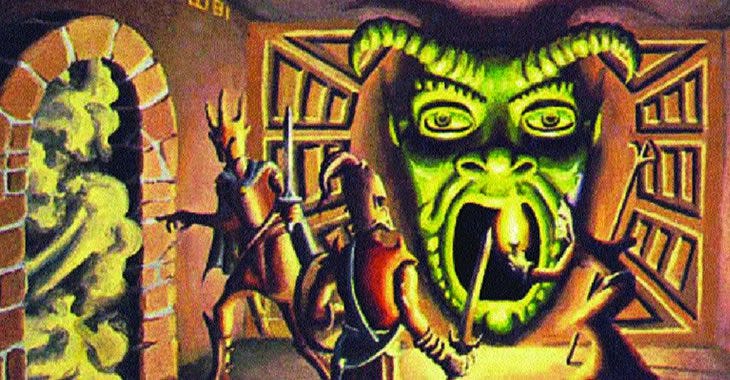
I’d love to test this. Take the art from ‘Tomb of Horrors’, strip it down to text, hand it to two GMs who’ve never read it and actually enjoy reading, and see what happens. I’d bet on two totally distinct adventures. No repeats.
That’s the same principle I apply to my own VI·VIII·X books. I keep visuals to a minimum. Not because I hate art, but because I don’t want to hand you my version of what’s written. I want yours. I want you, as a GM or reader, to build what you see, not borrow what I saw. That makes it yours and more powerful.
Here’s an example. In my latest adventure, I added a creature from another dimension. I described it like this:
The creature is from another plane. It is about the size of a medium dog, headless and tailless, with dark gray leathery skin that allows it to blend into any shadow or dark area. It has 16 tentacles extending horizontally from its body, eight on each side. Half of the tentacles are used for movement (thicker, with suction cups that also serve as sensory organs), while the other half are used for attacking, grappling, and feeding (thinner, ending in sharp bone blades used to immobilize prey). The creature uses the eight locomotion tentacles to sense vibrations. It feeds through a long dorsal opening and secretes a corrosive acid from its mouth to dissolve soft tissues, making them edible. Victims suffer a painful and horrific death.
Now stop. Read that again. Picture the creature. You’re a GM. You’re about to unleash it on your players. The version you just saw in your mind is yours, and probably nothing like what another GM would picture.
If I had included an illustration in the adventure, that mental image would vanish. In its place, a fixed picture. Yours, mine, anyone’s, doesn’t matter. The spell would be broken.
Take this AI-generated image, for instance. It’s not far from the description, not even too bad as AI outcome. But if I put it in the book, then that is what everyone sees. Where’s the space for imagination?
And that’s the heart of it. RPGs aren’t just games. They’re ones the most imagination-powered medium we have. And I’m not railing against “vibes,” or saying you’re wrong if you want a setting with visual flavor. This isn’t an anti-AI post. I’m not even against the standard of two or three images every five pages, though most folks never question why that’s the standard in the first place.
I’m just asking: what happens when we stop asking? If Poe, or Lovecraft, or any writer of their caliber had packed their stories with pictures, would we still be reading them the same way? Would we even still be reading them?
Or would we just be flipping pages, looking at someone else’s imagination instead of trusting our own?
One could argue that reading fiction is looking at someone else's imagination while using our own.
I agree with most of the post, but like you said, flavor is a big thing, especially in RPGs. Having beautiful art from skilled creators enhances a book for me.
AI-slop can rot in hell.
I can totally see where you’re coming from I heartily disagree that interpreting a monster yourself is “better”. My players have seen my interpretations of things a thousand times already, I WANT to see your vision. I want to see what visions the creator of this book made, I want to impart that flavor into my game. Why am I even running a module in the first place if I just want to impart my vision to players. The whole point of a playing module rather than just playing your own adventure is to discover the cool stuff someone else’s mind cooked up. If I’m playing Mork Borg, I WANT to see Johann Nohr’s art because I’m deliberately trying to engage with the world he created. The description of goblins in the MB bestiary is pretty standard, it’s that illustration of a wretched thing with a head too big and a face like a goblin shark that makes the MB Goblin so iconic.
I’ll say it like this, I could be handed a plate of unseasoned food and choose to flavor it myself with the types of spices I like. There’s nothing wrong with that. But sometimes I want to experience the flavors the chef specifically crafted, I wanna taste combinations I may have never thought of myself. I want to be blown away by the creativity of someone else.